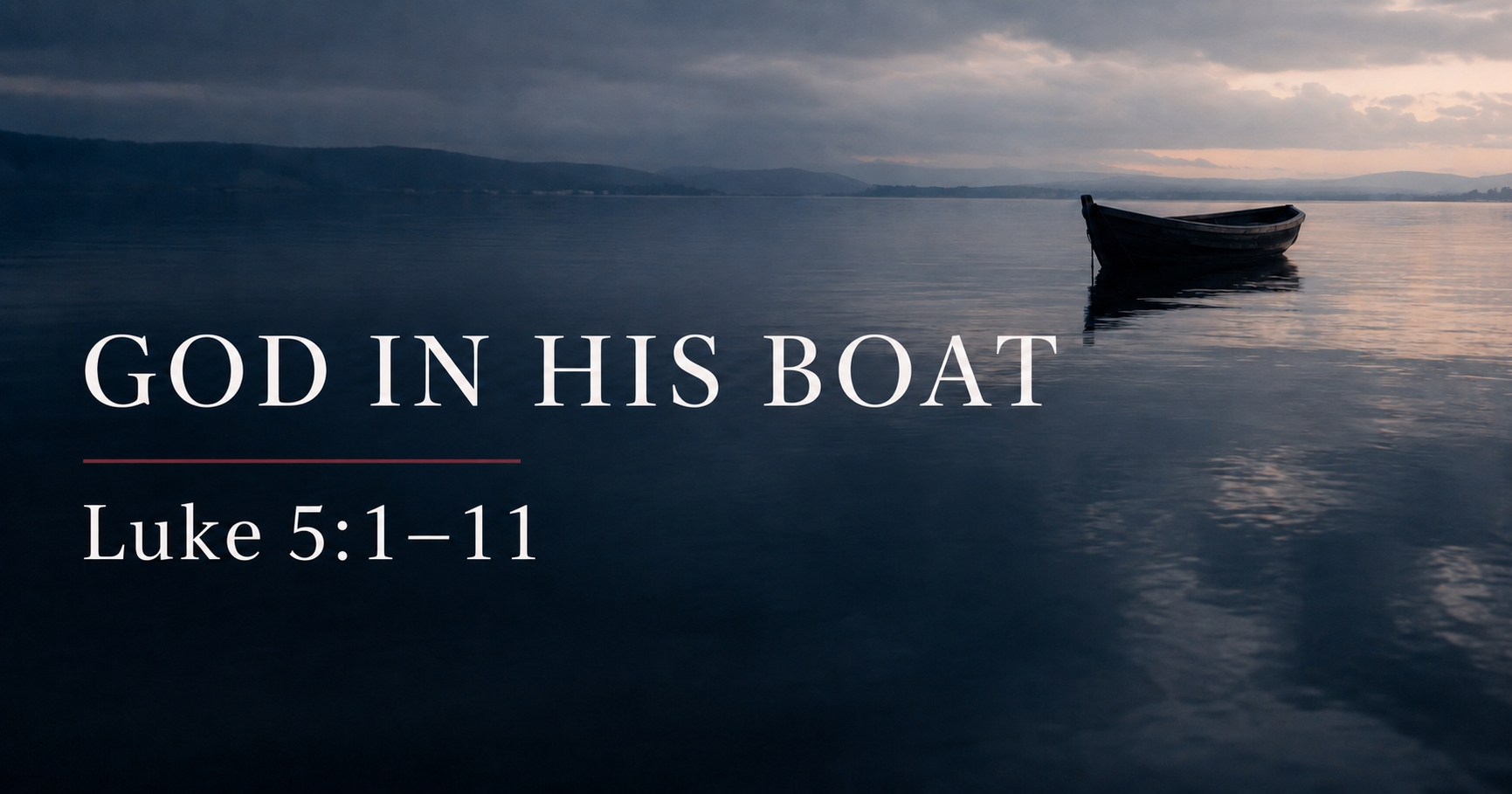
God In His Boat
What Peter’s encounter with Jesus teaches us about holiness,
sin, grace, and following Christ
Sermon Reflection: In Luke 5:1–11, Peter realizes that the One in his boat is no ordinary man, but the holy Christ. His encounter reveals the seriousness of our sin, the grace of Jesus who draws sinners near, and the call to leave everything and follow Him. This post is based on Pastor Ken’s sermon, “When Peter Realized God Was in His Boat.” Watch the full sermon below.
Peter had experienced the greatest catch of fish of his life. His nets were breaking. Both boats were filling. Yet when Peter realized what had happened, the fish no longer mattered.
He fell at Jesus’ knees and said, “Depart from me, for I am a sinful man, O Lord” (Luke 5:8).
In that moment, Peter realized that someone greater than a man was in his boat. In the presence of Jesus, he was in the presence of the holy God.
Pressing to Hear the Word of God
Luke 5 opens with a crowd pressing in on Jesus by the Lake of Gennesaret to hear the Word of God. Jesus had been preaching with authority, healing the sick, casting out demons, and declaring that He was the promised Messiah. When Jesus spoke, He was not merely explaining God’s Word as a preacher does. He was speaking the very words of God. His words carried divine authority.
This should cause us to ask a simple question: Are we pressing to hear the Word of God?
It is good to gather with God’s people on Sunday. But are we making room for His Word throughout the week? Are we pushing other things aside to press for time with God in His Word, or are we allowing the pressures of life to push His Word away from us?
Obeying Christ When We Do Not Understand
Jesus got into Simon Peter’s boat and taught the crowd from the water. Afterward, He told Peter, “Put out into the deep and let down your nets for a catch” (Luke 5:4). Peter had already fished all night. He knew fishing. He knew the best time to fish and where to fish. He had caught nothing. Now Jesus, likely a carpenter, was telling this experienced fisherman to go back out into deep water in the heat of the day.
Peter could have dismissed Jesus’ command. Instead, he said, “At your word, I will let down the nets” (Luke 5:5). Peter did not obey because the command made sense to him. He obeyed because he recognized Jesus as Master.
There are times when Christ’s Word challenges our experience, our preferences, and what we think is best. Faithful obedience means trusting Him anyway. Peter’s faith overcame his instincts as a fisherman.
The Creator in Control of Creation
When Peter and his partners obeyed, they caught such a great number of fish that their nets began to break. They called for help from the other boat, and both boats were filled to the point of sinking.
This was no ordinary catch.
It happened at the least ideal time and place. Peter knew that. He understood that nothing in his experience could explain what had happened. Jesus had shown His omniscience (knowing all things) and omnipotence (all-powerful) over the fish, the lake, and all creation.
Jesus is more than a carpenter. He is the eternal Son of God, the One through whom all things were made (John 1:1–3). He made the Sea of Galilee. He made the fish in it. He could command them to do exactly what He desired. And He did.
This was a miracle.
The holy, preincarnate Christ that Isaiah saw seated on the throne (Isaiah 6:1-8) is the holy, incarnate Christ in Peter’s boat.
When Peter Realized God Was in His Boat
Peter had already seen Jesus heal his mother-in-law. He had seen His power. But this miracle happened in Peter’s own area of expertise. It made everything clear.
Peter was overwhelmed at first by the enormous catch of fish. But then the fish did not matter anymore. He was overwhelmed by the presence of the holy God.
There were likely fish flopping all around him, but Peter fell at Jesus’ knees. His attention was no longer on the catch. It was on the Holy One before him. Peter did not call Jesus “Master” now. He called Him “Lord.”
In the light of Christ’s holiness, Peter saw himself clearly. He saw his sinfulness, guilt, and unworthiness. John MacArthur notes that Peter understood that if Jesus could see the depths of the lake, then Jesus could also see the depths of Peter’s heart.
That is what the holiness of God does. It exposes us. It reveals our sin.
Holy Fear Before a Holy Christ
Jesus is God, and His presence brings a holy fear (Matthew 17:1-8, Mark 4:35-41, Revelation 1:9-18).
Like Isaiah before him, Peter was undone in the presence of the holy God. Isaiah cried, “Woe is me!” Peter said, “Depart from me.” Both men recognized the same truth: sinful people cannot casually stand before a holy God.
We often want a view of God that is comfortable with our sin—a God who adjusts His standards to fit our desires and approves whatever we want. But the God revealed in Scripture is holy, righteous, and completely unlike us.
His holiness should make us uncomfortable with our sin. We should not be casual, flippant, or presumptuous about it. When we see Christ rightly, we begin to see our sin rightly. We recognize who He is and who we are. We feel the weight of the deserved separation and judgment we deserve. This is holy fear.
Jesus Did Not Depart From Peter
Peter’s fear was appropriate. Yet Jesus responded with grace: “Do not be afraid. From now on you will be catching men” (Luke 5:10). This actually means "Stop being fearful."
Jesus did not depart from Peter in judgment. He drew Peter near.
Peter did not need Jesus to leave him alone. He needed Jesus to save him from his sin. Though Peter was unworthy and fearful, Jesus called him to follow and gave him a new purpose.
This is the gospel.
We deserve separation from God because of our sin. We deserve His righteous judgment. But Jesus did not depart from us. The holy, preincarnate Christ that Isaiah saw came to us (John 1:14-15). While we were still sinners, Christ died for us. Through His death, He reconciles us to God (Romans 5:6–11). He is our Mediator, our Righteousness, and the One who satisfies God’s wrath against our sin.
JC Ryle reminds us that out of Christ, God is a consuming fire; but in Christ, He is a reconciled Father. Through repentance and faith in Jesus, sinners who deserve judgment can draw near to God with confidence and peace. Through Jesus, God does not depart from us, but reconciles us to Himself.
From Holy Fear to Holy Peace
Peter’s fear did not have the final word. Jesus told him to stop being afraid. The same is true for everyone reconciled to God through Christ. We should have a holy fear because of our sin, but we can also have holy peace because of what Christ has done.
God is high and holy, yet He dwells with the one who is contrite and lowly in spirit (Isaiah 57:15). He does not despise a broken and repentant heart (Psalm 51:17).
The right response to God’s holiness is not pretending that our sin is small. It is coming before Him honestly, broken over our sin in confession and repentance, and resting in the mercy Christ has provided.
Leaving Everything to Follow Jesus
Luke tells us that when Peter, James, and John brought their boats to land, “they left everything and followed him” (Luke 5:11). Peter left behind the greatest catch of his life because he had found Someone more valuable than two boatloads of fish. Jesus realigned Peter’s priorities. Nothing earthly compared to knowing and following the holy Christ.
The same Christ who forgives sinners also sends them. Both Isaiah and Peter had a woeful experience in the presence of the holy God, yet were drawn near and sent to minister. Peter would no longer catch fish; he would help bring people into the kingdom of God. Those whom God reconciles to Himself through Christ are sent to point others toward reconciliation through Christ (2 Corinthians 5:18–21).
Jesus is more valuable than anything we hold dear. He is worthy of our trust, our obedience, our worship, and our lives.
Gospel Connection
Peter deserved for Jesus to depart from him. Instead, Jesus called him near. We deserve separation from God because of our sin. But Jesus came to us. He lived the righteous life we could not live, died the death our sins deserve, and rose again in victory. Through Him, guilty sinners can be forgiven, reconciled to God, and sent out with a new purpose. The holy Christ is also the merciful Savior.
Key Takeaways
- Christ’s words carry divine authority and are worthy of our obedience.
- Faith obeys Jesus even when His command challenges our experience.
- Jesus is the Creator and Lord over all creation.
- Seeing Christ’s holiness helps us see our sin clearly.
- God’s holiness should make us uncomfortable with sin, leading us to repentance.
- Jesus does not depart from repentant sinners; He draws them near.
- In Christ, holy fear gives way to holy peace.
- Jesus is more valuable than anything we might leave behind to follow Him.
- Those reconciled to God are sent to help reconcile others to Him.
Questions for Reflection
- Are you pressing to hear the Word of God, or allowing other things to push it away?
- Where is Christ calling you to obey even when His Word challenges your experience or preferences?
- How does Peter’s response help you understand the holiness of Jesus?
- Are you taking your sin seriously before a holy God in a spirit of passionate repentance?
- Have you trusted Christ as the One who reconciles sinners to God?
- What might you be holding onto that keeps you from following Jesus wholeheartedly?
- Who is God calling you to point toward Christ this week?
Watch the Full Service
We invite you to watch the full worship service above and hear Pastor Ken’s complete message, “When Peter Realized God Was in His Boat,” from Luke 5:1–11.
As you listen, ask God to help you see Christ in His holiness, take sin seriously, repent, rest in His reconciling grace, and follow Him above everything else
More from Beyond Sunday